
The eBooks we sell are sold as a single-user licence and are intended for the end user only.
The sale of some eBooks are restricted to certain countries. To alert you to such restrictions, please select the country of the billing address of your credit or debit card you wish to use for payment.
For further information see https://www.wildy.com/ebook-formats
Once the order is confirmed an e-mail will be sent to you to allow you to download the eBook. For UK purchases this will be automatic. For purchases outside the UK a member of staff will need to confirm the sale. (Staff are available to do this during normal business hours, Mon-Fri 8:30-17:00 UK time)
All eBooks are supplied firm sale and cannot be returned. If you believe there is a fault with your eBook then contact us on ebooks@wildy.com and we will help in resolving the issue. This does not affect your statutory rights.
The relevance of Nietzsche's work to legal studies has, in recent years, been increasingly recognized by legal scholars, political theorists, cultural theorists and feminists.
Best known for his radical critique of Judeo Christian morality (which would, in itself, warrant describing him as a legal thinker), Nietzsche developed insights about the history and the purpose of punishment, the codification of morals and laws, and the possibilities for ethical and legal creativity in the age following the death of God. However, there has yet to be a book-length study (at least in the English language) devoted to the subject of Nietzsche and law.
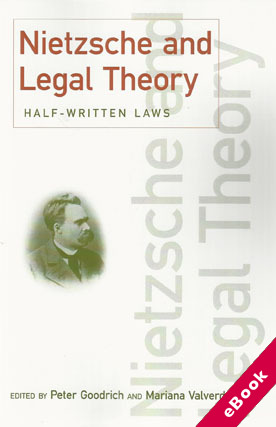
Nietzsche and Legal Theory is an anthology designed to provide legal and socio-legal scholars with a sense of the very wide range of projects and questions in whose pursuit Nietzsche's work can be useful. From medical ethics to criminology, from the systemic anti-Semitism of legal codes arising in Christian cultures, to the details of intellectual property debates about regulating the use of culturally significant objects, the contributors (from the fields of law, philosophy, criminology, cultural studies, and literary studies) demonstrate and enact the sort of creativity that Nietzsche associated with the 'free-spirits' to whom he addressed some of his most significant work.











