
The eBooks we sell are sold as a single-user licence and are intended for the end user only.
The sale of some eBooks are restricted to certain countries. To alert you to such restrictions, please select the country of the billing address of your credit or debit card you wish to use for payment.
For further information see https://www.wildy.com/ebook-formats
Once the order is confirmed an e-mail will be sent to you to allow you to download the eBook. For UK purchases this will be automatic. For purchases outside the UK a member of staff will need to confirm the sale. (Staff are available to do this during normal business hours, Mon-Fri 8:30-17:00 UK time)
All eBooks are supplied firm sale and cannot be returned. If you believe there is a fault with your eBook then contact us on ebooks@wildy.com and we will help in resolving the issue. This does not affect your statutory rights.
While scholars have rightly focussed on the importance of the landmark opinions of the United States Supreme Court and its Chief Justice, John Marshall, in the rise in influence of the Court in the Early Republic, the crucial role of the circuit courts in the development of a uniform system of federal law across the nation has largely been ignored.
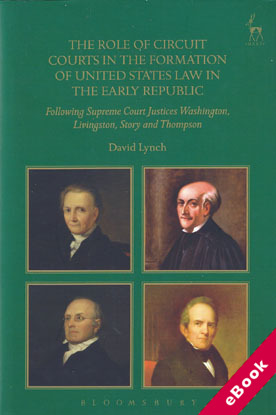
This book highlights the contribution of four Associate Justices (Washington, Livingston, Story andThompson) as presiding judges of their respective circuit courts during the Marshall era in order to establish that in those early years federal law grew from the 'inferior courts' upwards rather than down from the Supreme Court.
It does so after a reading of over 1,800 mainly circuit opinions and over 2,000 original letters which reveal the sources of law upon which the justices drew and their efforts through correspondence to achieve consistency across the circuits.
The documents examined present insights into momentous social, political, and economic issues facing the Union and how these justices dealt with them on circuit. Particular attention is paid to the different ways in which each justice contributed to the shaping of United States law on circuit and on the Court and in the case of Justices Livingston and Thompson also during their time on the New York State Supreme Court.











