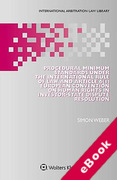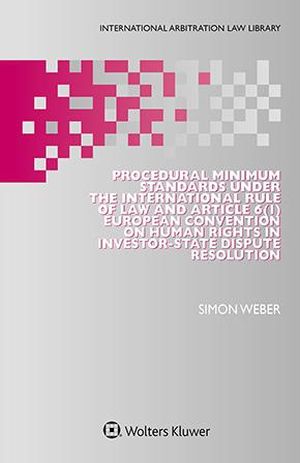
Procedural Minimum Standards under the International Rule of Law and Article 6(1) European Convention on Human Rights in Investor-State Dispute Resolution is a book that, for the first time, systematically sets out procedural minimum standards with which investor-State dispute resolution (ISDR) fora must comply under the international rule of law. It analyses these standards to determine the extent to which ISDR practice recognises or sidesteps them, thereby identifying potentially available solutions for the reform. In the context of ISDR, given the concerns from States, civil society, and other stakeholders about systemic issues with the current system, a debate has picked up speed concerning reform of the ISDR process.
By deducing procedural minimum standards from a primary manifestation of the rule of law – the right to a fair trial as enshrined in international human rights treaties, in particular as elaborated in the case law on Article 6(1) of the European Convention on Human Rights (ECHR) – the author highlights how having recourse to standards emanating from a system a multitude of States comply with (and many more follow independently) opens the door to greater global harmonisation of ISDR’s procedural and institutional features.
What’s in this book:
Systematic analysis of how the requirements of the procedural standards are complied with is detailed (with current and historical development perspectives) at the following stages of the arbitral process:
In addition to analysing about 300 judgements of the European Court of Human Rights (ECtHR) on the civil limb of Article 6(1) ECHR, the analysis also attends to provisions of the major international and regional human rights conventions insofar as they may be relevant to ISDR proceedings.
How this will help you:
By defining a scope for reform and setting out limits, this book provides an important contribution to the objective of the ongoing UNCITRAL Working Group III discussions. In addition to setting out a framework that should, in principle, be complied with under Article 6(1) ECHR, it discusses norms that can be included in any possible reform. In its practical survey of the subject and its thoroughly researched recommendations, the study bridges the gap between the legal regimes of procedural human rights and ISDR and suggests a normative template for future treaty drafting.