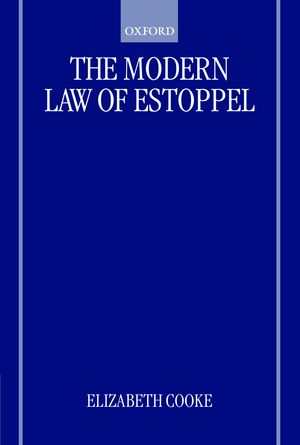
The law of estoppel by representation concerns those critical circumstances when the law will not allow a person to go back on what he has previously said. We might call it the law of consistency. It has developed, from very simple origins, into a complex of ideas, which have proved to be of great practical importance in areas as diverse as land law, contract, and family law.
Development continues, as does the interaction with other areas; changes in recent years in the law's conception of contract, and in its approach to problems of family property, as well as the growth of the law of restitution, have all had their impact on estoppel. The Modern Law of Estoppel seeks to explore, explain, and criticize the law of estoppel; to present a logical structure for it; and in particular to analyse the concept of 'unconscionability', which is now seen as a basis for the law.