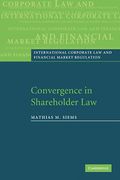
On the one hand, it can be argued that the increasing economic and political interdependence of countries has led to the convergence of national legal systems. On the other hand, advocates of the counterhypothesis maintain that this development is both unrealistic and unnecessary.
Mathias Siems examines the company law of the UK, the USA, Germany, France, Japan and China to see how this issue affects shareholder law. The author subsequently analyses economic and political factors which may or may not lead to convergence, and assesses the extent of this development. Thus, Convergence of Shareholder Law not only provides a thorough comparative legal analysis but also shows how company law interconnects with political forces and economic development and helps in evaluating whether harmonisation and shareholder protection should be enhanced.


Due to a technical issue some ebooks are not available to order.


Due to a technical issue some ebooks are not available to order.






Due to a technical issue some ebooks are not available to order.








Due to a technical issue some ebooks are not available to order.


Due to a technical issue some ebooks are not available to order.

Due to a technical issue some ebooks are not available to order.


Due to a technical issue some ebooks are not available to order.




Due to a technical issue some ebooks are not available to order.


Due to a technical issue some ebooks are not available to order.


Due to a technical issue some ebooks are not available to order.

Due to a technical issue some ebooks are not available to order.



Due to a technical issue some ebooks are not available to order.