
The eBooks we sell are sold as a single-user licence and are intended for the end user only.
The sale of some eBooks are restricted to certain countries. To alert you to such restrictions, please select the country of the billing address of your credit or debit card you wish to use for payment.
For further information see https://www.wildy.com/ebook-formats
Once the order is confirmed an e-mail will be sent to you to allow you to download the eBook. For UK purchases this will be automatic. For purchases outside the UK a member of staff will need to confirm the sale. (Staff are available to do this during normal business hours, Mon-Fri 8:30-17:00 UK time)
All eBooks are supplied firm sale and cannot be returned. If you believe there is a fault with your eBook then contact us on ebooks@wildy.com and we will help in resolving the issue. This does not affect your statutory rights.
Due to a technical issue some ebooks are not available to order.
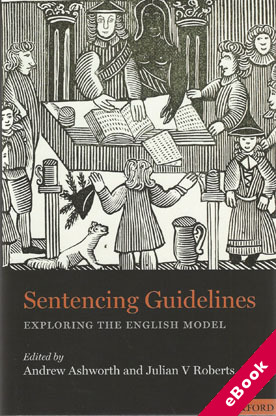
The politics of criminal sentencing has recently crystallised around the issue of whether and how a system of structured sentencing should inform judicial approaches to punishing criminals. Increasingly, structured sentencing guidelines are being introduce to frame judicial discretion.
This volume is the first to examine the experience in England and Wales in the light of international developments. This collection of essays begins with a clear and concise history of the guidelines as well as a description of how they function. Topics addressed include the effect of guidelines on judicial practice, the role of public opinion in developing sentencing guidelines, the role of the crime victim in sentencing guidelines, and the use of guidelines by practicing barristers.
In addition, the international dimension offers a comparative perspective: the English guidelines are explored by leading academics from the United States and New Zealand.
Although there is a vast literature on sentencing guidelines across the United States, the English guidelines have attracted almost no attention from scholars. As other jurisdictions look to introduce more structure to sentencing, the English scheme offers a real alternative to current US schemes.
Contributors include practicing lawyers, legal and socio-legal academics, and also scholars from several other countries including New Zealand and the United States, providing a multidisciplinary and cross-jurisdictional approach to sentencing. This book will be of interest to academics from law, sociology and criminology, legal practitioners, and indeed anyone else with an interest in sentencing, around the world.










