The eBooks we sell are sold as a single-user licence and are intended for the end user only.
The sale of some eBooks are restricted to certain countries. To alert you to such restrictions, please select the country of the billing address of your credit or debit card you wish to use for payment.
For further information see https://www.wildy.com/ebook-formats
Once the order is confirmed an e-mail will be sent to you to allow you to download the eBook. For UK purchases this will be automatic. For purchases outside the UK a member of staff will need to confirm the sale. (Staff are available to do this during normal business hours, Mon-Fri 8:30-17:00 UK time)
All eBooks are supplied firm sale and cannot be returned. If you believe there is a fault with your eBook then contact us on ebooks@wildy.com and we will help in resolving the issue. This does not affect your statutory rights.
Due to a technical issue some ebooks are not available to order.
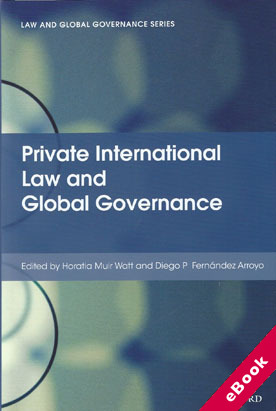
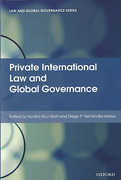
Contemporary debates about the changing nature of law engage theories of legal pluralism, political economy, social systems, international relations (or regime theory), global constitutionalism, and public international law.
Such debates reveal a variety of emerging responses to distributional issues which arise beyond the Western welfare state and new conceptions of private transnational authority. However, private international law tends to stand aloof, claiming process-based neutrality or the apolitical nature of private law technique and refusing to recognize frontiers beyond than those of the nation-state.
The crucial issue now is whether private international law can, or indeed should, survive as a discipline. This volume lays the foundations for a critical approach to private international law in the global era. While the governance of global issues such as health, climate, and finance clearly implicates the law, and particularly international law, its private law dimension is generally invisible.
This book develops the idea that the liberal divide between public and private international law has enabled the unregulated expansion of transnational private power in these various fields. It explores the potential of private international law to reassert a significant governance function in respect of new forms of authority beyond the state. To do so, it must shed a number of assumptions entrenched in the culture of the nation-state, but this will permit the discipline to expand its potential to confront major issues in global governance.
Due to a technical issue some ebooks are not available to order.
Due to a technical issue some ebooks are not available to order.

Due to a technical issue some ebooks are not available to order.
Due to a technical issue some ebooks are not available to order.
Due to a technical issue some ebooks are not available to order.
Due to a technical issue some ebooks are not available to order.