The eBooks we sell are sold as a single-user licence and are intended for the end user only.
The sale of some eBooks are restricted to certain countries. To alert you to such restrictions, please select the country of the billing address of your credit or debit card you wish to use for payment.
For further information see https://www.wildy.com/ebook-formats
Once the order is confirmed an e-mail will be sent to you to allow you to download the eBook. For UK purchases this will be automatic. For purchases outside the UK a member of staff will need to confirm the sale. (Staff are available to do this during normal business hours, Mon-Fri 8:30-17:00 UK time)
All eBooks are supplied firm sale and cannot be returned. If you believe there is a fault with your eBook then contact us on ebooks@wildy.com and we will help in resolving the issue. This does not affect your statutory rights.
Due to a technical issue some ebooks are not available to order.
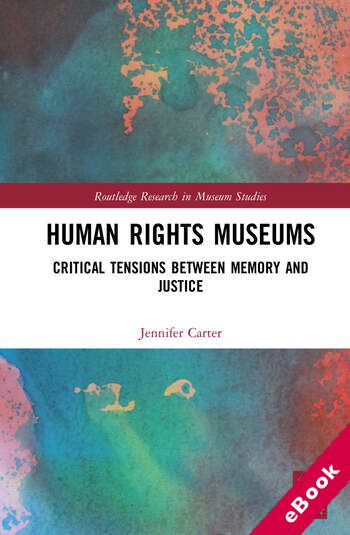
Human Rights Museums presents case studies that trace how calls for historical and social justice, and the commensurate rise of a rights regime have led to the emergence of a new museological genre: the human rights museum.
Presenting innovative field research conducted in new and emerging human rights museums across Asia and Latin America, the book adopts a broad museological approach. It does so by including national and community museums, as well as public and private museological initiatives, within its purview. Drawing on in-depth case studies about museums in Taiwan, Japan, Paraguay and Colombia - all discussed within their political and cultural contexts – the book examines the paradigmatic shift that has occurred within the museum field in the wake of the larger global transformations that have shaped contemporary geopolitics over the last 50 years. The diversity of geographical and political contexts, and the attention to lesser-known institutions within the canon of English museum studies literature, presents readers with a valuable opportunity to learn more about innovative museological models in non-English-speaking and non-Western contexts.
Human Rights Museums will appeal to academics, scholars and students of museum studies and related disciplines, and to museum professionals seeking to know more about the diverse and evolving roles of museums in contemporary society.