
The eBooks we sell are sold as a single-user licence and are intended for the end user only.
The sale of some eBooks are restricted to certain countries. To alert you to such restrictions, please select the country of the billing address of your credit or debit card you wish to use for payment.
For further information see https://www.wildy.com/ebook-formats
Once the order is confirmed an e-mail will be sent to you to allow you to download the eBook. For UK purchases this will be automatic. For purchases outside the UK a member of staff will need to confirm the sale. (Staff are available to do this during normal business hours, Mon-Fri 8:30-17:00 UK time)
All eBooks are supplied firm sale and cannot be returned. If you believe there is a fault with your eBook then contact us on ebooks@wildy.com and we will help in resolving the issue. This does not affect your statutory rights.
Due to a technical issue some ebooks are not available to order.
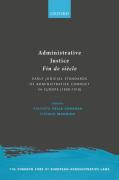
In the field of administrative law, there is no systematic body of rules similar to those characteristic of European civil codes. General principles are therefore of fundamental importance. This volume - the sixth in the series concerning the common core of European administrative laws - explores this importance through two strands.
Firstly, it examines in detail the relationship between general principles of law, such as due process, and sector-specific rules established by legislative and regulatory provisions, for example in licensing and disciplinary matters. Several questions about the nature of general principles emerge through this analysis. Are general principles about filling gaps? Or do they have a foundational role because they give meaning to the values that are shared by European legal systems, such as respect for the rule of law and for fundamental rights?
Secondly, this volume also explores the interaction between commonality and diversity in European administrative law. It considers whether there are shared standards of administrative conduct, including the duty to give reasons, or if there are fundamental differences with regard to non-European legal systems, such as that of China and Venezuela.
These questions are investigated through factual analysis, based on a set of hypothetical cases, which are discussed by national experts. This book then scrutinizes these questions to determine how commonality and diversity have extended and interact with one another, within and across legal systems, both diachronically and synchronically, over the course of a century. It shows that there are both unexpected areas of agreement between the European legal systems, notably concerning the right to be heard (expressed by the maxim audi alteram partem) and the duty to give reasons, and there are also areas of disagreement, for example as far as the right to remain silent vis à vis the administration (that is, nemo tenetur se detegere) is concerned.




Due to a technical issue some ebooks are not available to order.

Due to a technical issue some ebooks are not available to order.



Due to a technical issue some ebooks are not available to order.
Due to a technical issue some ebooks are not available to order.