The eBooks we sell are sold as a single-user licence and are intended for the end user only.
The sale of some eBooks are restricted to certain countries. To alert you to such restrictions, please select the country of the billing address of your credit or debit card you wish to use for payment.
For further information see https://www.wildy.com/ebook-formats
Once the order is confirmed an e-mail will be sent to you to allow you to download the eBook. For UK purchases this will be automatic. For purchases outside the UK a member of staff will need to confirm the sale. (Staff are available to do this during normal business hours, Mon-Fri 8:30-17:00 UK time)
All eBooks are supplied firm sale and cannot be returned. If you believe there is a fault with your eBook then contact us on ebooks@wildy.com and we will help in resolving the issue. This does not affect your statutory rights.
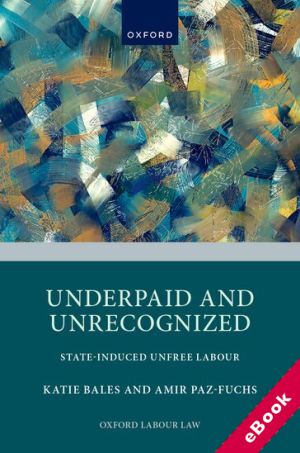
Unfree labour is not a relic of pre-modern economies, nor a peripheral concern within contemporary labour regulation. It is not confined to criminal enterprises or the illicit margins of the market. Rather, it is sustained, expanded, and legitimated by state institutions that claim to be its citizens' guardians. Underpaid and Unrecognized: State-Induced Unfree Labour begins from the premise that, in the UK, the modern state does not merely tolerate unfree labour; it produces and profits from it.
The rise of a precarious workforce has been the subject of study and concern over the past decade. But there is a growing sector of workers who enjoy even less protection due to their exclusion from traditional labour rights and regulations. Importantly, this work is not considered 'illegal', but rather is initiated and organised by governments. The book focuses on four UK case studies: prison work, workfare, work within immigration detention centres, and internships. This work creates surplus value for not only the State, but also for private corporations.
Authors Katie Bales and Amir Paz-Fuchs analyse the legal position of these workers and reflect on the growing privatisation of State functions Building on work developed by sociologists and socio-legal scholars, the authors develop the position that this labour should be considered 'unfree' and explore the ways in which the exploitation of such workers could be reduced through collective action, the recognition of workers' employment status, and the expansion of employment rights.