The eBooks we sell are sold as a single-user licence and are intended for the end user only.
The sale of some eBooks are restricted to certain countries. To alert you to such restrictions, please select the country of the billing address of your credit or debit card you wish to use for payment.
For further information see https://www.wildy.com/ebook-formats
Once the order is confirmed an e-mail will be sent to you to allow you to download the eBook. For UK purchases this will be automatic. For purchases outside the UK a member of staff will need to confirm the sale. (Staff are available to do this during normal business hours, Mon-Fri 8:30-17:00 UK time)
All eBooks are supplied firm sale and cannot be returned. If you believe there is a fault with your eBook then contact us on ebooks@wildy.com and we will help in resolving the issue. This does not affect your statutory rights.
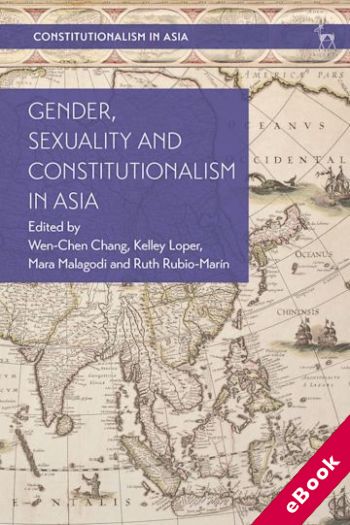
This book analyses the equal citizenship claims of women and sexual and gender diverse people across several Asian jurisdictions. The volume examines the rich diversity of constitutional responses to sex, gender, and sexuality in the region from a comparative perspective. Leading comparative constitutional law scholars identify 'opportunity structures' to explain the uneven advancement of gender equality through constitutional litigation and consider a combination of variables which shape the diverging trajectories of the jurisdictions in this study. These variables include:
The authors also embed the relevant constitutional and legal developments in their historical, political and social contexts. This deep contextual understanding of the relationship between sex, gender, sexuality, and constitutionalism greatly enriches the analysis. The case studies reflect a variety of constitutional structures, institutional designs, and contextual dynamics which may advance or impede developments with respect to sex, gender, and sexuality. As a whole, the chapters further an understanding of the constitutional domain as a fruitful site for advancing gender equality and the rights of sexual and gender diverse people.
The jurisdictions covered represent all Asian sub-regions including: East Asia (Japan, Taiwan, Hong Kong, and South Korea), South East Asia (Malaysia, Singapore, Philippines, and Indonesia), and South Asia (India, Nepal, Pakistan, and Sri Lanka). The introductory framework chapter situates these insights from the region within the broader global context of the evolution of gender constitutionalism.