The eBooks we sell are sold as a single-user licence and are intended for the end user only.
The sale of some eBooks are restricted to certain countries. To alert you to such restrictions, please select the country of the billing address of your credit or debit card you wish to use for payment.
For further information see https://www.wildy.com/ebook-formats
Once the order is confirmed an e-mail will be sent to you to allow you to download the eBook. For UK purchases this will be automatic. For purchases outside the UK a member of staff will need to confirm the sale. (Staff are available to do this during normal business hours, Mon-Fri 8:30-17:00 UK time)
All eBooks are supplied firm sale and cannot be returned. If you believe there is a fault with your eBook then contact us on ebooks@wildy.com and we will help in resolving the issue. This does not affect your statutory rights.
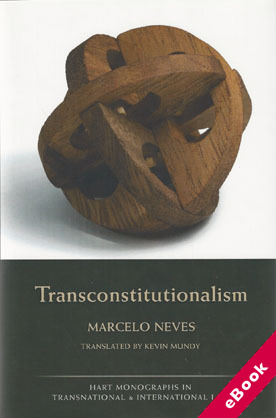
Transconstitutiononalism is a concept used to describe what happens to constitutional law when it is emancipated from the state, in which can be found the origins of constitutional law.
Transconstitutionalism does not exist because a multitude of new constitutions have appeared, but because other legal orders are now implicated in resolving basic constitutional problems. A transconstitutional problem entails a constitutional issue whose solution may involve national, international, supranational and transnational courts or arbitral tribunals, as well as native local legal institutions.
Transconstitutionalism does not take any single legal order or type of order as a starting-point or ultima ratio. It rejects both nation-statism and internationalism, supranationalism, transnationalism and localism as privileged spaces for solving constitutional problems. The transconstitutional model avoids the dilemma of 'monism versus pluralism'.
From the standpoint of transconstitutionalism, a plurality of legal orders entails a complementary and conflicting relationship between identity and alterity: constitutional identity is rearticulated on the basis of alterity. Rather than seeking a 'Herculean Constitution', transconstitutionalism tackles the many-headed Hydra of constitutionalism, always looking for the blind spot in one legal system and reflecting it back against the many others found in the world's legal orders.