<?xml version="1.0" encoding="UTF-8"?>
<book>
  <always-in-stock type="integer" nil="true"></always-in-stock>
  <au>Virgo, Graham </au>
  <availability>OK</availability>
  <ba></ba>
  <book-series-id type="integer" nil="true"></book-series-id>
  <bookofthemonth type="integer" nil="true"></bookofthemonth>
  <co>&lt;b&gt;I The Fundamental Principles&lt;/b&gt;;
 
1. The Essence of Restitution ;
2. Themes and Controversies ;
&lt;b&gt;II Unjust Enrichment&lt;/b&gt;;
 
3. The Principle of Unjust Enrichment ;
4. Enrichment ;
5. At the Expense of the Plaintiff ;
&lt;b&gt;III The Grounds of Restitution for the Purpose of Establishing Unjust Enrichment&lt;/b&gt;;
 
6. Principles Underlying the Recognition of Grounds of Restitution ;
7. Ignorance ;
8. Mistake ;
9. Compulsion ;
10. Exploitation ;
11. Necessity ;
12. Failure of Comsideration ;
13. Incapacity ;
14. Restitution from Public Authorities ;
&lt;b&gt;IV Restitution for Wrongs&lt;/b&gt;;
 
15. General Principles ;
16. Restitution for Torts ;
17. Restitution for Breach of Contract ;
18. Restitution for Equitable Wrongdoing ;
19. Criminal Offences ;
&lt;b&gt;V Proprietary Restitutionary Claims&lt;/b&gt;;
 
20. Establishing Proprietary Restitutionaroy Claims ;
21. Restitutionary Claims and Remedies to Vindicate Property Rights ;
22. The Defence of Bona Fide Purchase ;
&lt;b&gt;VI The General Defences and Bars to Restitutionary Claims&lt;/b&gt;;
 
23. Fundamental Principles and General Bars ;
24. Defences Arising from Changes in the Defendant's Circumstances ;
25. Passing on and Mitigation of Loss ;
26. Illegality ;
27. Incapacity ;
28. Limitation Periods and Laches ;</co>
  <comments></comments>
  <cp>UK</cp>
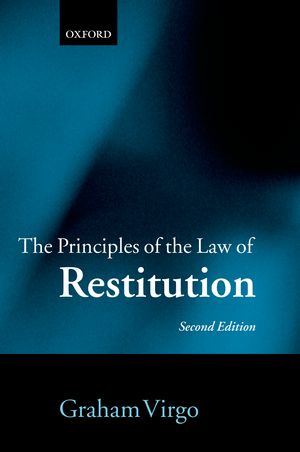
  <df2>The second edition of this textbook lays out the key principles which underlie that body of law known as the law of restitution. This subject was recognised by the House of Lords as a discrete body of law fifteen years ago - although restitutionary principles have, in fact, been evolving for over 200 years. Since the recognition of the subject by the House of Lords the subject has developed dramatically, and even more rapidly since the publication of the first edition of this text in 1999.&lt;p&gt;

The law of restitution is concerned with the questions of when restitutionary remedies may be awarded. These are remedies which operate to deprive defendants of gains rather than to compensate claimants for losses. The traditional approach to the subject assumes that restitutionary remedies are only available to reverse unjust enrichment. In this book the auhtor asserts that restitutionary remedies are triggered by three different types of action:-
&lt;ul&gt;
&lt;li&gt;The reversal of the defendant's unjust enrichment

&lt;li&gt;The commission of a wrong by the defendant

&lt;li&gt;The vindication of the claimant's property rights
&lt;/ul&gt;
Since the publication of the first edition of this book this model has increasingly been recognised by the courts. In this book the law is examined through analyses of key cases and relevant statutory provisions, demonstrating the way in which the law in used to solve a wide variety of legal problems. The very different views of academics on the nature and ambit of the subject are also carefully considered. The result will be invaluable to students on restitution courses at every level, practitioners and those engaged in research on the subject.
&lt;ul&gt;
&lt;li&gt;A comprehensive source of up to date primary and secondary materials
&lt;li&gt;A source recognized and cited by the judiciary
&lt;li&gt;Includes the latest developments in the area such as the vindication of property rights principle, restitutionary remedies for breach of contract, restitutionary remedies against public authorities, and the defence of change of position
&lt;li&gt;Useful for a range of jurisdictions, including England and Wales, Australia, New Zealand, Canada, and in the Far East.

&lt;/ul&gt;</df2>
  <ed></ed>
  <en>2nd ed</en>
  <fmc></fmc>
  <fmt>Paperback</fmt>
  <hide type="integer" nil="true"></hide>
  <id type="integer">107394</id>
  <isbn>0199298505</isbn>
  <isbn13>9780199298501</isbn13>
  <isbnnew></isbnnew>
  <modified-timestamp type="datetime">2009-12-19T00:23:58Z</modified-timestamp>
  <new-edition-id type="integer" nil="true"></new-edition-id>
  <newbookslist-heading-id type="integer">36</newbookslist-heading-id>
  <nv></nv>
  <offerprice type="float">0.0</offerprice>
  <paperback-edition-id type="integer" nil="true"></paperback-edition-id>
  <pduk type="datetime">2006-07-01T00:00:00Z</pduk>
  <permalink>the-principles-of-the-law-of-restitution</permalink>
  <pp type="integer" nil="true"></pp>
  <print-on-demand type="integer">1</print-on-demand>
  <product-type-id type="integer">1</product-type-id>
  <prukh type="float">39.9900016784668</prukh>
  <pu>Oxford University Press</pu>
  <publisher-id type="integer">2008</publisher-id>
  <specialoffer></specialoffer>
  <subscription-domestic-price type="float">0.0</subscription-domestic-price>
  <subscription-domestic-vat type="float">0.0</subscription-domestic-vat>
  <subscription-overseas-price type="float">0.0</subscription-overseas-price>
  <subscription-type type="integer">0</subscription-type>
  <ti>The Principles of the Law of Restitution </ti>
  <vat type="float" nil="true"></vat>
  <xx></xx>
</book>