The eBooks we sell are sold as a single-user licence and are intended for the end user only.
The sale of some eBooks are restricted to certain countries. To alert you to such restrictions, please select the country of the billing address of your credit or debit card you wish to use for payment.
For further information see https://www.wildy.com/ebook-formats
Once the order is confirmed an e-mail will be sent to you to allow you to download the eBook. For UK purchases this will be automatic. For purchases outside the UK a member of staff will need to confirm the sale. (Staff are available to do this during normal business hours, Mon-Fri 8:30-17:00 UK time)
All eBooks are supplied firm sale and cannot be returned. If you believe there is a fault with your eBook then contact us on ebooks@wildy.com and we will help in resolving the issue. This does not affect your statutory rights.
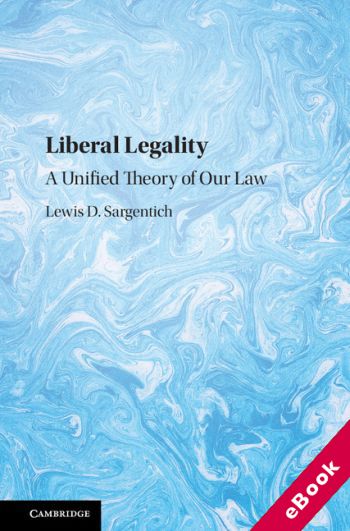
In his new book, Lewis D. Sargentich shows how two different kinds of legal argument - rule-based reasoning and reasoning based on principles and policies - share a surprising kinship and serve the same aspiration.
He starts with the study of the rule of law in life, a condition of law that serves liberty - here called liberal legality. In pursuit of liberal legality, courts work to uphold people's legal entitlements and to confer evenhanded legal justice. Judges try to achieve the control of reason in law, which is manifest in law's coherence, and to avoid forms of arbitrariness, such as personal moral judgment.
Sargentich offers a unified theory of the diverse ways of doing law, and shows that they all arise from the same root, which is a commitment to liberal legality.