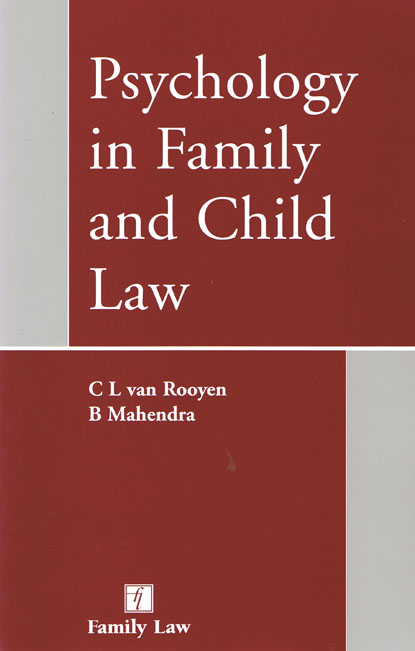
Pyschology in Family and Child Law

Subjects:
Family Law
Contents:
Part I- General
The psychologist in family and child law
Methodology
Psychological testing
Childhood abuse and emotional harm
Understanding emotional harm
Childhood sexual abuse
Parental alienation
Understanding attachment
Understanding defence mechanisms
Maladaptive personality development
Psychological treatment
Part II-Disorders of childhood and adolescence
Common childhood disturbances
Emotional impairment and disorders
Adjustment difficulties
Mental retardation and learning difficulties
Attention deficit hyperactivity disorder(ADHD)
Behavioural disorders
Eating disorders
Pervasive developmental disorders
Summary Part III- Adult mental health
Introduction
Stress related disorders
Anxiety based disorders
Affective disorders
Personality disorders
Psychosis
Substance related disorders
Impulse control disorders
Factitious disorders
Summary of adult disorders
Appendix I Some specimen instructions
Appendix II Psychometric tests and questionnaires
Bibliography

ISBN13: 9781846610677
ISBN: 1846610672
Published: September 2007
Publisher: Family Law
Country of Publication: UK
Binding: Paperback
Price: £45.00

This new work, a companion volume to Adult Psychiatry in Family and Child Law, examines all relevant aspects of adult and child psychology in relation to family and child care law. Psychology deals with behaviour – and the behaviour of parents, other carers and children in relation to one another and the world at large has obvious interest to the courts which need to determine issues coming before them.

The book adopts a practical approach and explains psychological concepts, including the measurements employed, so that professionals working in this area can gain an informed understanding of the subject matter. Where there is an overlap between psychology and psychiatry, this is given further detailed consideration.

Psychology in Family and Child Law is essential reading for those professionals who need to identify psychological issues, instruct the relevant experts and evaluate psychological evidence when it is presented to them.