The eBooks we sell are sold as a single-user licence and are intended for the end user only.
The sale of some eBooks are restricted to certain countries. To alert you to such restrictions, please select the country of the billing address of your credit or debit card you wish to use for payment.
For further information see https://www.wildy.com/ebook-formats
Once the order is confirmed an e-mail will be sent to you to allow you to download the eBook. For UK purchases this will be automatic. For purchases outside the UK a member of staff will need to confirm the sale. (Staff are available to do this during normal business hours, Mon-Fri 8:30-17:00 UK time)
All eBooks are supplied firm sale and cannot be returned. If you believe there is a fault with your eBook then contact us on ebooks@wildy.com and we will help in resolving the issue. This does not affect your statutory rights.
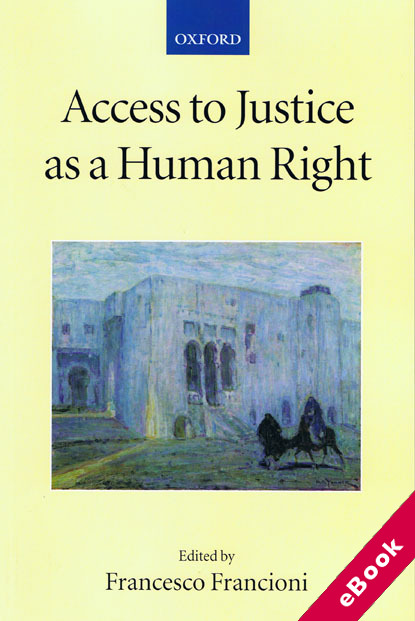
In international law, as in any other legal system, respect and protection of human rights can be guaranteed only by the availability of effective judicial remedies. When a right is violated or damage is caused, access to justice is of fundamental importance for the injured individual and it is an essential component of the rule of law. Yet, access to justice as a human right remains problematic in international law. First, because individual access to international justice remains exceptional and based on specific treaty arrangements, rather than on general principles of international law; second, because even when such right is guaranteed as a matter of treaty obligation, other norms or doctrines of international law may effectively impede its exercise, as in the case of sovereign immunity or non reviewability of UN Security Council measures directly affecting individuals. Further, even access to domestic legal remedies is suffering because of the constraints put by security threats, such as terrorism, on the full protection of freedom and human rights.This collection of essays offers seven distinct perspectives on the present status of access to justice: its development in customary international law, the stress put on it in times of emergency, its problematic exercise in the case of violations of the law of war, its application to torture victims, its development in the case law of the UN Human Rights Committee and of the European Court of Human Rights, its application to the emerging field of environmental justice, and finally access to justice as part of fundamental rights in European law.