The eBooks we sell are sold as a single-user licence and are intended for the end user only.
The sale of some eBooks are restricted to certain countries. To alert you to such restrictions, please select the country of the billing address of your credit or debit card you wish to use for payment.
For further information see https://www.wildy.com/ebook-formats
Once the order is confirmed an e-mail will be sent to you to allow you to download the eBook. For UK purchases this will be automatic. For purchases outside the UK a member of staff will need to confirm the sale. (Staff are available to do this during normal business hours, Mon-Fri 8:30-17:00 UK time)
All eBooks are supplied firm sale and cannot be returned. If you believe there is a fault with your eBook then contact us on ebooks@wildy.com and we will help in resolving the issue. This does not affect your statutory rights.
Due to a technical issue some ebooks are not available to order.
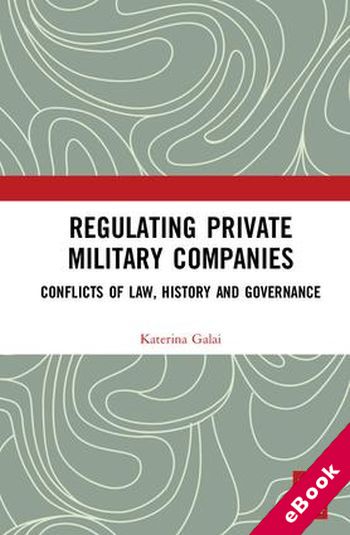
This work examines the ability of existing and evolving PMC regulation to adequately control private force and challenges the capacity of international law to deliver accountability in the event of PMC misconduct.From medieval to early modern history, private soldiers dominated the military realm and were fundamental to the waging of wars until the rise of a national citizen army. Today, private military companies (PMCs) are again a significant force, performing various security, logistics, and strategy functions across the world. Unlike mercenaries or any other form of irregular force, PMCs acquired a corporate legal personality, a legitimising status that alters the governance model of today.
Drawing on historical examples of different forms of governance, the relationship between neoliberal states and private military companies is conceptualised here as a form of a ‘shared governance.’ It reflects states’ reliance on PMCs relinquishing a degree of their power and transferring certain functions to the private sector. As non-state actors grow in authority, wielding power and making claims to legitimacy through self-regulation, other sources of law also become imaginable and relevant to enact regulation and invoke responsibility.