The eBooks we sell are sold as a single-user licence and are intended for the end user only.
The sale of some eBooks are restricted to certain countries. To alert you to such restrictions, please select the country of the billing address of your credit or debit card you wish to use for payment.
For further information see https://www.wildy.com/ebook-formats
Once the order is confirmed an e-mail will be sent to you to allow you to download the eBook. For UK purchases this will be automatic. For purchases outside the UK a member of staff will need to confirm the sale. (Staff are available to do this during normal business hours, Mon-Fri 8:30-17:00 UK time)
All eBooks are supplied firm sale and cannot be returned. If you believe there is a fault with your eBook then contact us on ebooks@wildy.com and we will help in resolving the issue. This does not affect your statutory rights.
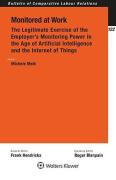
Monitored at Work is a legal study, beyond the traditional privacy paradigm, that explores the historical and conceptual foundations of the employer’s monitoring power, tracing its evolution from the Industrial Revolution to the most recent developments in data science – Artificial Intelligence (AI) and Internet of Things (IoT). Employers deploy these technologies to evaluate work performance, assess personal characteristics, and safeguard property, health, and safety. The book highlights how technological innovation has reshaped managerial authority and examines the influential role of technology developers in this process. The study further analyses how these developments affect the enjoyment of employees’ fundamental rights within the European Union (EU) legal framework, including the rights to non-discrimination, freedom of expression, and freedom of assembly and association. The book offers a holistic understanding of the employer’s monitoring power and examines the conditions for its legitimate exercise under the General Data Protection Regulation (GDPR) and the Artificial Intelligence Act (AI Act). It provides a normative critique of both Regulations, exploring the specific protection needs of employees.
What’s in this book:
The Author’s focus is on:
Furthermore, the analysis integrates relevant jurisprudence from the European Court of Human Rights (ECtHR) and the European Court of Justice (ECJ) to assess the legitimacy of monitoring practices. The study also outlines potential solutions to address existing limitations and gaps in the GDPR and the AI Act, drawing in particular on the Data Protection Impact Assessment (DPIA, Article 35 GDPR), Article 88 GDPR, and recent legislative developments introduced by the Platform Work Directive (PWD).
How this will help you:
Through its assessment of the effectiveness of EU legislation in safeguarding employees against the illegitimate exercise of the employer’s monitoring power, this book offers a comprehensive examination of how AI and IoT-enabled monitoring technologies challenge employees’ rights. By elucidating the legal and ethical implications of these technologies, it equips practitioners with the tools to anticipate and mitigate compliance risks under both the GDPR and the AI Act. Furthermore, the book contributes to the ongoing scholarly and policymaking debate by analysing emerging regulatory developments that could further shape the future of the digitally monitored workplace.