The eBooks we sell are sold as a single-user licence and are intended for the end user only.
The sale of some eBooks are restricted to certain countries. To alert you to such restrictions, please select the country of the billing address of your credit or debit card you wish to use for payment.
For further information see https://www.wildy.com/ebook-formats
Once the order is confirmed an e-mail will be sent to you to allow you to download the eBook. For UK purchases this will be automatic. For purchases outside the UK a member of staff will need to confirm the sale. (Staff are available to do this during normal business hours, Mon-Fri 8:30-17:00 UK time)
All eBooks are supplied firm sale and cannot be returned. If you believe there is a fault with your eBook then contact us on ebooks@wildy.com and we will help in resolving the issue. This does not affect your statutory rights.
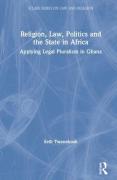
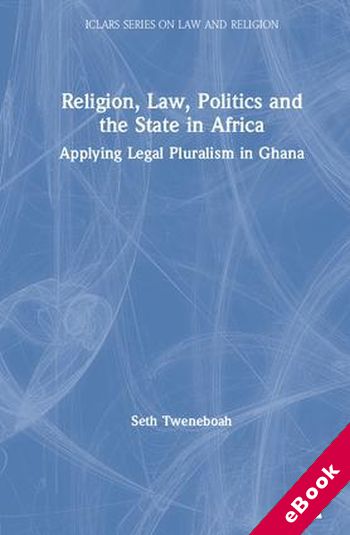
Applying a legal pluralist framework, this study examines the complex interrelationships between religion, law and politics in contemporary Ghana, a professedly secular State characterised by high levels of religiousity. It aims to explore legal, cultural and moral tensions created by overlapping loci of authority (state actors, traditional leaders and religious functionaries). It contends that religion can function as an impediment to Ghana’s secularity and also serve as an integral tool for realising the State’s legal ideals and meeting international human rights standards. Using three case studies – legal tensions, child witchcraft accusations and same-sex partnerships – the study illustrates the ways that the entangled and complicated connections between religion and law compound Ghana’s secular orientation. It suggests that legal pluralism is not a mere analytical framework for describing tensions, but ought to be seen as part of the solution. The study contributes to advancing knowledge in the area of the interrelationships between religion and law in contemporary African public domain.
This book will be a valuable resource for those working in the areas of Law and Religion, Religious Studies, African Studies, Political Science, Legal Anthropology and Socio-legal Studies.