The eBooks we sell are sold as a single-user licence and are intended for the end user only.
The sale of some eBooks are restricted to certain countries. To alert you to such restrictions, please select the country of the billing address of your credit or debit card you wish to use for payment.
For further information see https://www.wildy.com/ebook-formats
Once the order is confirmed an e-mail will be sent to you to allow you to download the eBook. For UK purchases this will be automatic. For purchases outside the UK a member of staff will need to confirm the sale. (Staff are available to do this during normal business hours, Mon-Fri 8:30-17:00 UK time)
All eBooks are supplied firm sale and cannot be returned. If you believe there is a fault with your eBook then contact us on ebooks@wildy.com and we will help in resolving the issue. This does not affect your statutory rights.
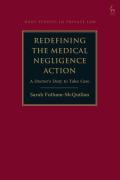
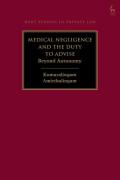
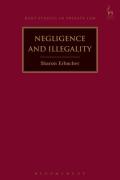
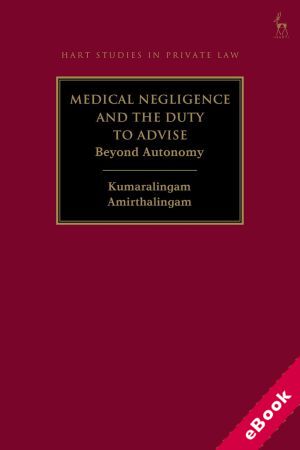
This book argues that patient autonomy and medical negligence make for strange bedfellows. The emphasis on autonomy has distorted orthodox negligence principles, contributing to uncertainty and angst amongst healthcare professionals while eroding trust in the doctor-patient relationship.
This work takes the current discourse beyond autonomy – which focuses on the rights of the patient, to agency and shared decision-making – which focus on the relationship between doctor and patient. The core argument is built on a review of the theoretical foundations of negligence and the philosophical conceptions of autonomy. Provocatively, this work argues against a rights-based approach to negligence – which can be confrontational – in favour of a human obligations approach, which is collaborative and thus well suited to the doctor-patient relationship.
Drawing on the theoretical analysis, the book identifies doctrinal anomalies in the duty of care, standard of care, causation, and damage. It critically analyses landmark UK Supreme Court cases, including Chester v Afshar, Montgomery v Lanarkshire Health Board, and McCulloch v Forth Valley Health Board, arguing that the law is increasingly detached from the realities of medical practice and reasonable expectations of patients. Primarily based on UK law, the work also discusses Australian, Canadian, and Singaporean law.
The book is aimed at the medical and legal fraternities as well as students and scholars of tort law. Doctors and lawyers will gain fresh insights into medical negligence; scholars will find an alternative perspective to orthodoxy with rich material to rethink theory and doctrine in negligence.