The eBooks we sell are sold as a single-user licence and are intended for the end user only.
The sale of some eBooks are restricted to certain countries. To alert you to such restrictions, please select the country of the billing address of your credit or debit card you wish to use for payment.
For further information see https://www.wildy.com/ebook-formats
Once the order is confirmed an e-mail will be sent to you to allow you to download the eBook. For UK purchases this will be automatic. For purchases outside the UK a member of staff will need to confirm the sale. (Staff are available to do this during normal business hours, Mon-Fri 8:30-17:00 UK time)
All eBooks are supplied firm sale and cannot be returned. If you believe there is a fault with your eBook then contact us on ebooks@wildy.com and we will help in resolving the issue. This does not affect your statutory rights.
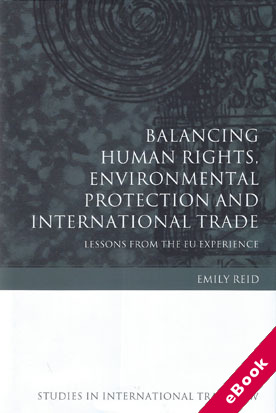
This book explores the means by which economic liberalisation can be reconciled with human rights and environmental protection in the regulation of international trade. It is primarily concerned with identifying the lessons the international community can learn, specifically in the context of the WTO, from decades of European Community and Union experience in facing this question.
The book demonstrates first that it is possible to reconcile the pursuit of economic and non-economic interests, that the EU has found a mechanism by which to do so, and that the application of the principle of proportionality is fundamental to the realisation of this. It is argued that the EU approach can be characterised as a practical application of the principle of sustainable development. Secondly, from the analysis of the EU experience, this book identifies fundamental conditions crucial to achieving this ‘reconciliation’. Thirdly, the book explores the implications of lessons from the EU experience for the international Community. In so doing it assesses both the potential and limits of the existing international regulatory framework for such reconciliation.
The book develops a deeper understanding of the inter-relationship between the legal regulation of economic and non-economic development, adding clarity to the debate in a controversial area. It argues that a more holistic approach to the consideration of ‘development’, encompassing economic and non-economic concerns - ‘sustainable’ development - is not only desirable in principle but realisable in practice.