The eBooks we sell are sold as a single-user licence and are intended for the end user only.
The sale of some eBooks are restricted to certain countries. To alert you to such restrictions, please select the country of the billing address of your credit or debit card you wish to use for payment.
For further information see https://www.wildy.com/ebook-formats
Once the order is confirmed an e-mail will be sent to you to allow you to download the eBook. For UK purchases this will be automatic. For purchases outside the UK a member of staff will need to confirm the sale. (Staff are available to do this during normal business hours, Mon-Fri 8:30-17:00 UK time)
All eBooks are supplied firm sale and cannot be returned. If you believe there is a fault with your eBook then contact us on ebooks@wildy.com and we will help in resolving the issue. This does not affect your statutory rights.
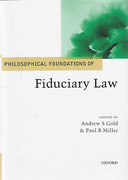
Fiduciary law is a critically important body of law. Fiduciary duties ensure the integrity of a remarkable variety of relationships, institutions, and organizations. They apply to relationships of great personal significance, including in some jurisdictions the relationship between parents and children.
They structure a wide variety of commercial relationships, and they are essential to the regulation of relationships between professional service providers and their clients, including relationships between lawyer and client, doctor and patient, and investment manager and client.
Fiduciary duties, perhaps uniquely in private law, challenge traditional ways of marking the boundaries between private and public law, inasmuch as they figure prominently in public governance. Indeed, there is even a storied tradition of thinking of the authority of the state in fiduciary terms. Notwithstanding its importance, fiduciary law has been woefully under-analysed by legal theorists.
Filling this gap with a series of chapters by leading theorists, this book includes chapters on: the nature of fiduciary relationships, the connection between fiduciary duties and morality, the content and significance of fiduciary loyalty, the economic significance of fiduciary law, the application of fiduciary principles to public law and international law, the import of fiduciary relationships to theories of authority, and various other fundamental topics in the field.
In many cases, new and important questions are raised by the book's chapters. Indeed, this book not only offers a much-needed theoretical assessment of fiduciary topics, it defines the field going forward, setting an agenda for future philosophical study of fiduciary law.