The eBooks we sell are sold as a single-user licence and are intended for the end user only.
The sale of some eBooks are restricted to certain countries. To alert you to such restrictions, please select the country of the billing address of your credit or debit card you wish to use for payment.
For further information see https://www.wildy.com/ebook-formats
Once the order is confirmed an e-mail will be sent to you to allow you to download the eBook. For UK purchases this will be automatic. For purchases outside the UK a member of staff will need to confirm the sale. (Staff are available to do this during normal business hours, Mon-Fri 8:30-17:00 UK time)
All eBooks are supplied firm sale and cannot be returned. If you believe there is a fault with your eBook then contact us on ebooks@wildy.com and we will help in resolving the issue. This does not affect your statutory rights.
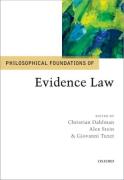
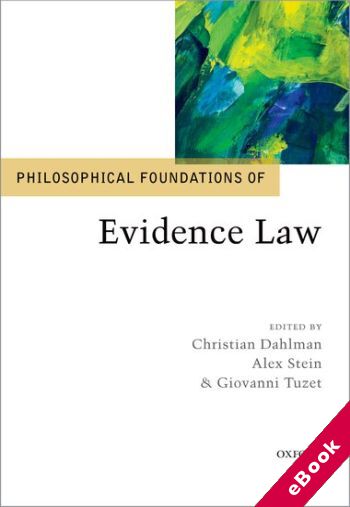
Philosophy has a strong presence in evidence law and the nature of evidence is a highly debated topic in both general and social epistemology; legal theorists working in the evidence law area draw on different underlying philosophical theories of knowledge, inference and probability. Core evidentiary concepts and principles, such as the presumption of innocence, standards of proof, and others, reply on moral and political philosophy for their understanding and interpretation.
Written by leading scholars across the globe, this volume brings together philosophical debates on the nature and function of evidence, proof, and law of evidence. It presents a cross-disciplinary overview of central issues in the theory and methodology of legal evidence and covers a wide range of contemporary debates on topics such as truth, proof, economics, gender, and race.
The volume covers different theoretical approaches to legal evidence, including the Bayesian approach, scenario theory and inference to the best explanation. Divided in to five parts, Philosophical Foundations of Evidence Law, covers different theoretical approaches to legal evidence, including the Bayesian approach, scenario theory and inference to the best explanation.