The eBooks we sell are sold as a single-user licence and are intended for the end user only.
The sale of some eBooks are restricted to certain countries. To alert you to such restrictions, please select the country of the billing address of your credit or debit card you wish to use for payment.
For further information see https://www.wildy.com/ebook-formats
Once the order is confirmed an e-mail will be sent to you to allow you to download the eBook. For UK purchases this will be automatic. For purchases outside the UK a member of staff will need to confirm the sale. (Staff are available to do this during normal business hours, Mon-Fri 8:30-17:00 UK time)
All eBooks are supplied firm sale and cannot be returned. If you believe there is a fault with your eBook then contact us on ebooks@wildy.com and we will help in resolving the issue. This does not affect your statutory rights.
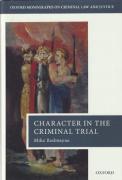
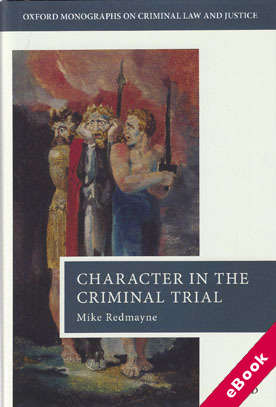
If a defendant is on trial for a crime such as burglary, to what extent should the fact that he has a previous conviction for burglary feature in his trial? Should the prosecution be allowed to tell the jury about the previous conviction as evidence that the defendant is more likely to have committed burglary? Should the judge give the defendant a longer sentence because he has a previous conviction?
These are the fundamental questions examined in Character in the Criminal Trial. Including an in-depth analysis of the character evidence provisions of the Criminal Justice Act 2003, this book assesses the arguments for and against using character evidence to prove a defendant's guilt. It explores the sentencing provisions in the same Act, as well as the general use of criminal record and other character evidence to aggravate and mitigate sentence.
Issues examined in the course of the book include: psychological and philosophical debates about the stability of character; criminological research on recidivism and the nature of criminal careers; ethical debates about the use of prior behaviour to prove current or future offending; the process of reasoning underlying the use of bad character evidence; whether bad character evidence is prejudicial; and the use of risk assessment instruments to classify offenders as dangerous.
By combining insights from law, psychology, criminology, and philosophy, Redmayne reassesses the use of character in the criminal trial and reflects on the significance of the law's increasing emphasis on character.