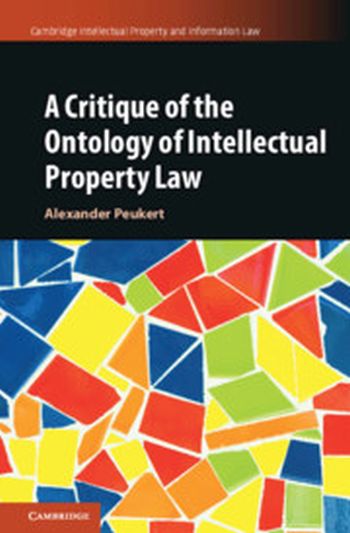
Intellectual property (IP) law operates with the ontological assumption that immaterial goods such as works, inventions, and designs exist, and that these abstract types can be owned like a piece of land. Alexander Peukert provides a comprehensive critique of this paradigm, showing that the abstract IP object is a speech-based construct, which first crystalised in the eighteenth century. He highlights the theoretical flaws of metaphysical object ontology and introduces John Searle's social ontology as a more plausible approach to the subject matter of IP. On this basis, he proposes an IP theory under which IP rights provide their holders with an exclusive privilege to use reproducible 'Master Artefacts.' Such a legal-realist IP theory, Peukert argues, is both descriptively and prescriptively superior to the prevailing paradigm of the abstract IP object. This work was originally published in German and was translated by Gill Mertens.