The eBooks we sell are sold as a single-user licence and are intended for the end user only.
The sale of some eBooks are restricted to certain countries. To alert you to such restrictions, please select the country of the billing address of your credit or debit card you wish to use for payment.
For further information see https://www.wildy.com/ebook-formats
Once the order is confirmed an e-mail will be sent to you to allow you to download the eBook. For UK purchases this will be automatic. For purchases outside the UK a member of staff will need to confirm the sale. (Staff are available to do this during normal business hours, Mon-Fri 8:30-17:00 UK time)
All eBooks are supplied firm sale and cannot be returned. If you believe there is a fault with your eBook then contact us on ebooks@wildy.com and we will help in resolving the issue. This does not affect your statutory rights.
Due to a technical issue some ebooks are not available to order.
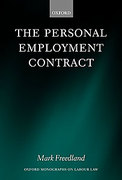
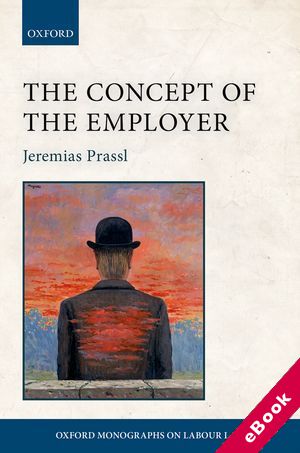
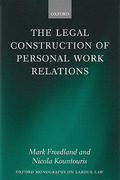
Employment law has increasingly struggled to adapt to complex modern work arrangements, from agency work to corporate groups. This book suggests that the reason for this failure can be found in our concept of the employer, which has become riddled with internal contradictions in its search for a unitary employer, the counterparty to a bilateral contract, through a series of multi-functional tests focussed on the exercise of a range of employer functions. As a result of this tension, full employment law coverage is restricted to a narrow scenario where a single legal entity exercises all employer functions - a paradigm far from the reality of modern labour markets characterized by a fragmentation of work, from the rise of employment agencies and service companies to corporate groups and Private Equity investors. These problems can only be addressed by a careful reconceptualization and the development of a functional concept of the employer.
The book draws on existing models in English, German, and European law to develop a definition of the employer as the entity, or combination of entities, exercising functions regulated in a particular domain of employment law. Each of the two strands of the current concept is addressed in turn to demonstrate how a more openly multi-functional approach can successfully overcome the rigidities of the current notion without abandoning a coherent underlying framework. It fills a crucial gap in employment law and corporate law with its analysis of the defects in our current understanding of the employer, and in developing a new functional concept designed to overcome the problems identified.





Due to a technical issue some ebooks are not available to order.

Due to a technical issue some ebooks are not available to order.
Due to a technical issue some ebooks are not available to order.