The eBooks we sell are sold as a single-user licence and are intended for the end user only.
The sale of some eBooks are restricted to certain countries. To alert you to such restrictions, please select the country of the billing address of your credit or debit card you wish to use for payment.
For further information see https://www.wildy.com/ebook-formats
Once the order is confirmed an e-mail will be sent to you to allow you to download the eBook. For UK purchases this will be automatic. For purchases outside the UK a member of staff will need to confirm the sale. (Staff are available to do this during normal business hours, Mon-Fri 8:30-17:00 UK time)
All eBooks are supplied firm sale and cannot be returned. If you believe there is a fault with your eBook then contact us on ebooks@wildy.com and we will help in resolving the issue. This does not affect your statutory rights.
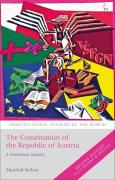
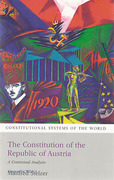
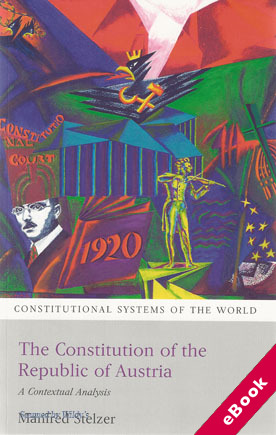
The Constitution of the Republic of Austria originated in 1920. From the beginning it represented a compromise between deeply opposed political parties with widely divergent moral and political principles.
The Constitution deliberately lacked substantive content, was formal in character, and was concerned only with the framework for the everyday political process. Constitutional amendments were, and remain, rare events. As a result case law interpreting the constitution tended to be conservative in outlook; controversial cases were considered a matter for constitutional amendment rather than constitutional interpretation.
Only comparatively recently, in the 1980s, has the Constitutional Court adopted a more expansive constitutional jurisprudence, especially in the field of fundamental rights. While this was to some extent an inevitable result of the influence of the ECtHR, it meant for instance that the principle of proportionality became enshrined in Austrian fundamental rights theory.
The Constitutional Court even saw fit to set limits to Parliament’s power to amend the Constitution. Becoming a member of the EU in 1995 presented Austria with new challenges, leading inevitably to the creation of a Constitutional Convention and, eventually, major amendments to the Constitution in 2008. This book shows how the Austrian Constitution has been shaped and interpreted by the fundamental events in Austria’s modern history.
At the same time it emphasises the way in which the Constitution establishes a parliamentary system, with additional presidential features, limited, in turn, by Austria’s federal structure and the parliaments of nine states.