The eBooks we sell are sold as a single-user licence and are intended for the end user only.
The sale of some eBooks are restricted to certain countries. To alert you to such restrictions, please select the country of the billing address of your credit or debit card you wish to use for payment.
For further information see https://www.wildy.com/ebook-formats
Once the order is confirmed an e-mail will be sent to you to allow you to download the eBook. For UK purchases this will be automatic. For purchases outside the UK a member of staff will need to confirm the sale. (Staff are available to do this during normal business hours, Mon-Fri 8:30-17:00 UK time)
All eBooks are supplied firm sale and cannot be returned. If you believe there is a fault with your eBook then contact us on ebooks@wildy.com and we will help in resolving the issue. This does not affect your statutory rights.
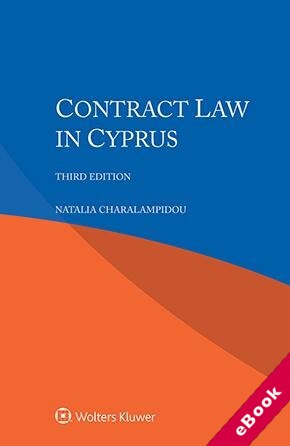
Derived from the renowned multi-volume International Encyclopaedia of Laws, this practical analysis of the law of contracts in Cyprus covers every aspect of the subject – definition and classification of contracts, contractual liability, relation to the law of property, good faith, burden of proof, defects, penalty clauses, arbitration clauses, remedies in case of non-performance, damages, power of attorney, and much more. Lawyers who handle transnational contracts will appreciate the explanation of fundamental differences in terminology, application, and procedure from one legal system to another, as well as the international aspects of contract law. Throughout the book, the treatment emphasizes drafting considerations.
An introduction in which contracts are defined and contrasted to torts, quasi-contracts, and property is followed by a discussion of the concepts of ‘consideration’ or ‘cause’ and other underlying principles of the formation of contract. Subsequent chapters cover the doctrines of ‘relative effect’, termination of contract, and remedies for non-performance. The second part of the book, recognizing the need to categorize an agreement as a specific contract in order to determine the rules which apply to it, describes the nature of agency, sale, lease, building contracts, and other types of contract. Facts are presented in such a way that readers who are unfamiliar with specific terms and concepts in varying contexts will fully grasp their meaning and significance.
Its succinct yet scholarly nature, as well as the practical quality of the information it provides, make this book a valuable time-saving tool for business and legal professionals alike. Lawyers representing parties with interests in Cyprus will welcome this very useful guide, and academics and researchers will appreciate its value in the study of comparative contract law.