The eBooks we sell are sold as a single-user licence and are intended for the end user only.
The sale of some eBooks are restricted to certain countries. To alert you to such restrictions, please select the country of the billing address of your credit or debit card you wish to use for payment.
For further information see https://www.wildy.com/ebook-formats
Once the order is confirmed an e-mail will be sent to you to allow you to download the eBook. For UK purchases this will be automatic. For purchases outside the UK a member of staff will need to confirm the sale. (Staff are available to do this during normal business hours, Mon-Fri 8:30-17:00 UK time)
All eBooks are supplied firm sale and cannot be returned. If you believe there is a fault with your eBook then contact us on ebooks@wildy.com and we will help in resolving the issue. This does not affect your statutory rights.
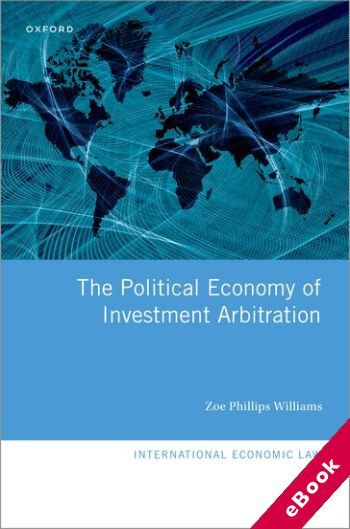
The Political Economy of Investment Arbitration asks how political institutions and actors in the host state of an investment contribute to the emergence of investor-state disputes. Combining insights from international relations and political economy, it considers two opposing explanations for investor-state disputes: shifting state preferences toward FDI, or the lack of state capacity to maintain an investment-friendly environment.
This book's overarching conclusion is that democratic institutions in host states contribute to the emergence of investor-state disputes. Williams argues that at the heart of many investor-state disputes are highly politicized distributional conflicts involving a range of domestic interest groups. Indeed, it is often pressure from these groups, whether through voting, protests or lobbying, which motivates states to take the policy decisions that are subsequently subject to investors' legal challenges. Thus, this monograph demonstrates that in the face of the potentially high costs posed by investment arbitration, governments continue to take measures which may harm investors in order to pursue specific policy goals. More importantly, these disputes are not only the result of corruption or weak rule of law, but of measures which are taken at the behest of broader interest groups and relate to clear public policy concerns. This has important implications of our normative assessment of the regime and is highly relevant to current debates in both international law and international political economy about the relationship between investment treaties and domestic politics.