The eBooks we sell are sold as a single-user licence and are intended for the end user only.
The sale of some eBooks are restricted to certain countries. To alert you to such restrictions, please select the country of the billing address of your credit or debit card you wish to use for payment.
For further information see https://www.wildy.com/ebook-formats
Once the order is confirmed an e-mail will be sent to you to allow you to download the eBook. For UK purchases this will be automatic. For purchases outside the UK a member of staff will need to confirm the sale. (Staff are available to do this during normal business hours, Mon-Fri 8:30-17:00 UK time)
All eBooks are supplied firm sale and cannot be returned. If you believe there is a fault with your eBook then contact us on ebooks@wildy.com and we will help in resolving the issue. This does not affect your statutory rights.
Due to a technical issue some ebooks are not available to order.
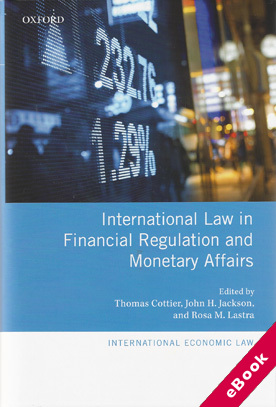
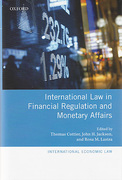
The early twenty-first century has seen a conspicuous absence of formal international law concerning money and finance. This book argues that this lack of formal international regulation was a significant contributing factor to the global financial crisis that began in 2007.
It focuses on this lack of global substantive principles and 'hard law' rules in the field of financial regulation and monetary affairs, and analyses the emerging framework within international law that aims to govern financial institutions and markets. The global financial crisis has demonstrated the essential need for financial and monetary regulatory reform, and for the establishment of appropriate mechanisms for the settlement of financial disputes and for the regulation of cross-border financial institutions.
This book therefore presents the foundations of solutions that could fill these critical gaps in international financial law. It addresses cross-border issues, financial regulation, and provides detailed analyses of monetary policies and regulation.
This book is an updated collection of papers first published in the Special Edition of the Journal of International Economic Law on 'The Quest for International Law in Financial Regulation and Monetary Affairs' (Volume 12, Number 3, September 2010), which also show that the regulatory hands-off approach was not replicated in other areas of international economic law.
International trade regulation witnessed an increased number of international rules and the reinforcement of a rule-oriented, if not rule-based, approach. Judicial dispute settlement and retaliation, exclusively based upon international ruling and authorization, was reinforced. Given the importance of trade regulation and WTO law, which has an established institutional and legal framework, the book therefore provides a much-needed comparative approach.
Due to a technical issue some ebooks are not available to order.






Due to a technical issue some ebooks are not available to order.
Due to a technical issue some ebooks are not available to order.
Due to a technical issue some ebooks are not available to order.

Due to a technical issue some ebooks are not available to order.



Due to a technical issue some ebooks are not available to order.

Due to a technical issue some ebooks are not available to order.