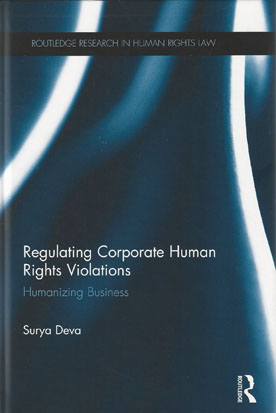
The quest to establish an effective regulatory mechanism to ensure that corporations comply with human rights responsibilities has gained momentum in the last decade or so, with the announcement of the Global Compact in 1999, the revision of OECD Guidelines as well as the ILO Tripartite Deceleration in 2000, and the drafting of the Human Rights Norms in 2003.
However, despite these efforts, no robust regulatory mechanism is in sight to provide effective remedies to victims of corporate human rights abuses. Against this background this book provides a theoretical framework to overcome regulatory challenges experienced in holding multinational corporations (MNCs) accountable for violation of human rights.
Based on a critical evaluation of six "representative" regulatory initiatives, this book will show how the existing regulatory framework is inadequate because of a three-fold deficiency: the framework does not prescribe clear human rights standards, offers weak rationales for compliance, and is supported by a deficient or underdeveloped implementation-cum-enforcement mechanism.
It will then go on to propose an "integrated theory" of regulation to remedy the inadequacy of the existing regulatory framework. The theory seeks to achieve integration between business issues and human rights issues, as well as between the "why", "what" and "how" of corporate human rights responsibility discourse, setting out potential available modes of implementation, levels of operation and types of sanctions.
This book will be of interest to students and scholars of human rights, international law, international relations and business ethics.