The eBooks we sell are sold as a single-user licence and are intended for the end user only.
The sale of some eBooks are restricted to certain countries. To alert you to such restrictions, please select the country of the billing address of your credit or debit card you wish to use for payment.
For further information see https://www.wildy.com/ebook-formats
Once the order is confirmed an e-mail will be sent to you to allow you to download the eBook. For UK purchases this will be automatic. For purchases outside the UK a member of staff will need to confirm the sale. (Staff are available to do this during normal business hours, Mon-Fri 8:30-17:00 UK time)
All eBooks are supplied firm sale and cannot be returned. If you believe there is a fault with your eBook then contact us on ebooks@wildy.com and we will help in resolving the issue. This does not affect your statutory rights.
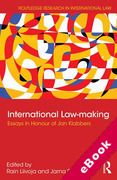
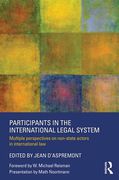
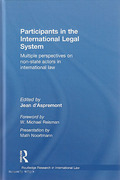
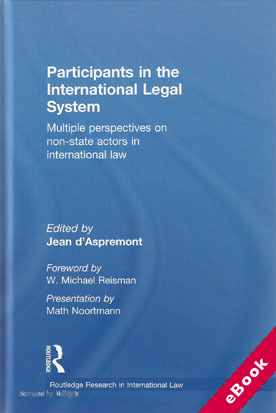
The international legal system has weathered sweeping changes over the last decade for new participants have emerged. Indeed, international law-making and law-enforcement processes have become multi-layered and the number of actors involved herein has proven unprecedented.
This growing importance of non-State actors at the law-making and law-enforcement levels has generated a lot of new scholarly studies on the topic. While it has remained uncontested that non-State actors like individuals, insurgents, multinational corporations and even terrorist groups are nowadays – albeit differently – playing an important role on the international plane, international legal scholarship has been riddled by controversy regarding the question of their status in international law.
The book features contributions by renowned scholars each of whom will look at a region, theory or tradition of international law, and will consider how that approach to international law has determined the understanding of the role and status of non-State actors within that particular school of thought.
The book takes a critical approach as it seeks to gauge the extent to which each conception and understanding of international law is instrumental to that perception of non-State actors. In undertaking this study the book will necessarily assess the current position of the State in the international legal order and examine the contemporary changes that have affected the State itself.