The eBooks we sell are sold as a single-user licence and are intended for the end user only.
The sale of some eBooks are restricted to certain countries. To alert you to such restrictions, please select the country of the billing address of your credit or debit card you wish to use for payment.
For further information see https://www.wildy.com/ebook-formats
Once the order is confirmed an e-mail will be sent to you to allow you to download the eBook. For UK purchases this will be automatic. For purchases outside the UK a member of staff will need to confirm the sale. (Staff are available to do this during normal business hours, Mon-Fri 8:30-17:00 UK time)
All eBooks are supplied firm sale and cannot be returned. If you believe there is a fault with your eBook then contact us on ebooks@wildy.com and we will help in resolving the issue. This does not affect your statutory rights.
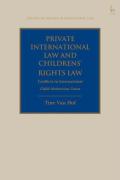
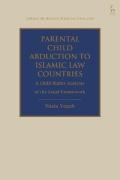
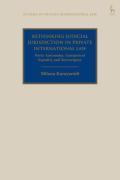
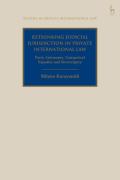
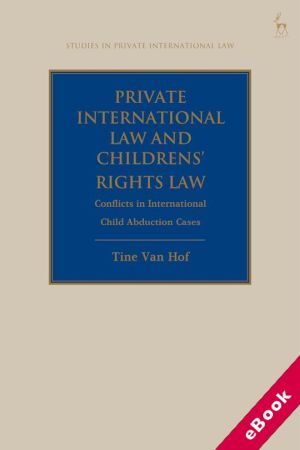
How do private international law and children's rights law interact-and conflict-in international child abduction cases?
This book examines the relationship between two legal fields when courts decide on cross-border child abduction. While private international law prioritises the child's prompt return and applies the best interests principle in abstracto, children's rights law demands an in concreto, individualised assessment of the child's best interests. These differing approaches can lead to legal friction in practice.
Through a detailed analysis of legal instruments and supranational case law, the book explores how these conflicts arise and how they might be resolved. Using the theoretical lens of international law's diversification and expansion, it identifies nine conflict-management tools, grouped into four categories: coordination, hierarchy, priority, and harmony. It argues that two of these tools offer promising solutions.
The book evaluates 839 cases from the CJEU, ECtHR, the UN Committee on the Rights of the Child, and national courts in Belgium, England & Wales, Ireland, the Netherlands, and Switzerland. This empirical study assesses how effectively the proposed tools address conflicts between the two legal fields.
Offering clear recommendations for lawmakers, international organisations, and courts, the book provides a roadmap for fostering constructive relationships between legal fields. It is an essential resource for scholars of private international law, judges and practitioners in cross-border family law, and policymakers working at the intersection of international law and children's rights.