The eBooks we sell are sold as a single-user licence and are intended for the end user only.
The sale of some eBooks are restricted to certain countries. To alert you to such restrictions, please select the country of the billing address of your credit or debit card you wish to use for payment.
For further information see https://www.wildy.com/ebook-formats
Once the order is confirmed an e-mail will be sent to you to allow you to download the eBook. For UK purchases this will be automatic. For purchases outside the UK a member of staff will need to confirm the sale. (Staff are available to do this during normal business hours, Mon-Fri 8:30-17:00 UK time)
All eBooks are supplied firm sale and cannot be returned. If you believe there is a fault with your eBook then contact us on ebooks@wildy.com and we will help in resolving the issue. This does not affect your statutory rights.
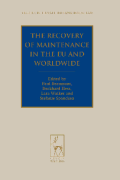
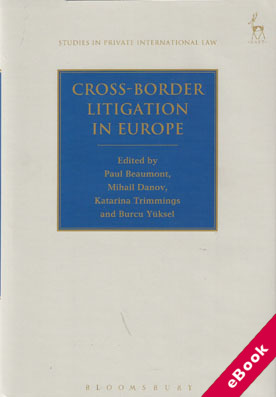
This substantial and original book examines how the EU Private International Law (PIL) framework is functioning and considers its impact on the administration of justice in cross-border cases within the EU.
It grew out of a major project (ie EUPILLAR: European Union Private International Law: Legal Application in Reality) financially supported by the EU Civil Justice Programme. The research was led by the Centre for Private International Law at the University of Aberdeen and involved partners from the Universities of Freiburg, Antwerp, Wroclaw, Leeds, Milan and Madrid (Complutense).
The contributors address the specific features of cross-border disputes in the EU by undertaking a comprehensive analysis of the Court of Justice of the EU ('CJEU') and national case law on the Brussels I, Rome I and II, Brussels IIa and Maintenance Regulations. Part I discusses the development of the EU PIL framework.
Part II contains the national reports from 26 EU Member States. Parts III (civil and commercial) and IV (family law) contain the CJEU case law analysis and several cross-cutting chapters. Part V briefly sets the agenda for an institutional reform which is necessary to improve the effectiveness of the EU PIL regime.
This comprehensive research project book will be of interest to researchers, students, legal practitioners, judges and policy-makers who work, or are interested, in the field of private international law.