The eBooks we sell are sold as a single-user licence and are intended for the end user only.
The sale of some eBooks are restricted to certain countries. To alert you to such restrictions, please select the country of the billing address of your credit or debit card you wish to use for payment.
For further information see https://www.wildy.com/ebook-formats
Once the order is confirmed an e-mail will be sent to you to allow you to download the eBook. For UK purchases this will be automatic. For purchases outside the UK a member of staff will need to confirm the sale. (Staff are available to do this during normal business hours, Mon-Fri 8:30-17:00 UK time)
All eBooks are supplied firm sale and cannot be returned. If you believe there is a fault with your eBook then contact us on ebooks@wildy.com and we will help in resolving the issue. This does not affect your statutory rights.
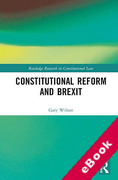
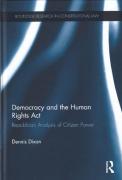
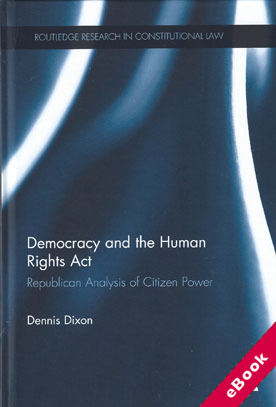
This book discusses the extent to which the UK Human Rights Act successfully balances protection of rights and democracy. It is generally accepted that the Act prevents government from violating fundamental rights, but the extent to which the Act can legitimately be overridden as a result of public opinion and participation is less clear. The work considers the Act's effect on this popular element of the British Constitution.
It uses analytical tools from republican political theory to explore the claim that the Act achieved a reconciliation between the protection of rights and democracy. In particular, it employs republican analysis of domination to consider how the Human Rights Act could operate so that public opinion invigilates legislative responses to judicial decisions.
The key question is whether judicial decisions under the Human Rights Act serve to 'remove, reduce or replace' opportunities for the electorate to control judicial decision-making, remembering always that the electorate is seldom engaged in politics, but should it chose to, its ability to do so is at the heart of democracy.
The study also examines the difficulty of isolating national constitutional forms where bills of rights are internationalised as with the European Convention on Human Rights. The book will be a valuable resource for students and academics researching constitutional legal theory, and comparative constitutional law. While the focus in on the UK HRA, broader theoretical issues of constitutional review will have significant international interest.