The eBooks we sell are sold as a single-user licence and are intended for the end user only.
The sale of some eBooks are restricted to certain countries. To alert you to such restrictions, please select the country of the billing address of your credit or debit card you wish to use for payment.
For further information see https://www.wildy.com/ebook-formats
Once the order is confirmed an e-mail will be sent to you to allow you to download the eBook. For UK purchases this will be automatic. For purchases outside the UK a member of staff will need to confirm the sale. (Staff are available to do this during normal business hours, Mon-Fri 8:30-17:00 UK time)
All eBooks are supplied firm sale and cannot be returned. If you believe there is a fault with your eBook then contact us on ebooks@wildy.com and we will help in resolving the issue. This does not affect your statutory rights.
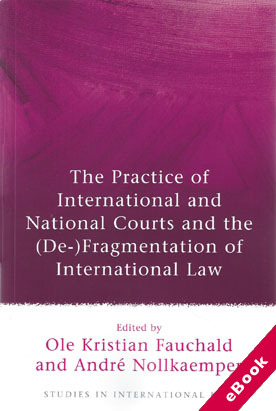
In recent decades there has been a considerable growth in the activities of international tribunals and the establishment of new tribunals. Furthermore, supervisory bodies established to control compliance with treaty obligations have adopted decisions in an increasing number of specific cases. National courts further add to the practice of adjudication of claims based on international law.
While this increasing practice of courts and supervisory bodies strengthens the adjudicatory process in international law, this development also poses challenges to the unity of international law. Most of these courts operate within their own special regime (functional, regional, or national) and will primarily interpret and apply international law within the framework of that particular regime. The role of domestic courts poses special challenges, as the powers of such courts to give effect to international law, as well their actual practice in applying such law, will be coloured by national law.
Against the background of differing normative appraisals of the phenomenon of fragmentation, this book aims to enhance our understanding of how international and national courts can, and do, contribute to or mitigate problems associated with fragmentation. It contains case studies from international regimes (including the WTO, the IMF, investment arbitration and the ECtHR) and from various national jurisdictions (including Japan, Norway, Switzerland and the UK), providing an improved basis for conclusions to be drawn in the final chapter. In particular this conclusion examines the principles and techniques that international and national courts have applied to counteract the negative effects of fragmentation.