The eBooks we sell are sold as a single-user licence and are intended for the end user only.
The sale of some eBooks are restricted to certain countries. To alert you to such restrictions, please select the country of the billing address of your credit or debit card you wish to use for payment.
For further information see https://www.wildy.com/ebook-formats
Once the order is confirmed an e-mail will be sent to you to allow you to download the eBook. For UK purchases this will be automatic. For purchases outside the UK a member of staff will need to confirm the sale. (Staff are available to do this during normal business hours, Mon-Fri 8:30-17:00 UK time)
All eBooks are supplied firm sale and cannot be returned. If you believe there is a fault with your eBook then contact us on ebooks@wildy.com and we will help in resolving the issue. This does not affect your statutory rights.
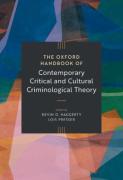
The Oxford Handbook of Contemporary Critical and Cultural Criminological Theory is a crucial scholarly resource for contemporary theorizing about crime, harm, and justice. Departing from earlier etiological or structural approaches, this volume highlights the rich and evolving field of theorizing in criminology by bringing together critical and cultural criminologies as conjoined subfields.
This Handbook draws together a wide body of empirical work examining institutional processes and cultural practices in relation to crime and the criminal justice system. With this lens of inquiry, traditional binaries—including that between "meaning" and "material arrangement"—are no longer sustainable. Across thirty-one chapters, the volume provides in-depth and accessible reviews of the main critical/cultural approaches to research in criminology and foregrounds key international debates. It promotes the recognition that political orders are founded on narratives of crime, systems of surveillance, and punishment, and that meaning is tied to their regulation. Critical criminology and cultural theories share a mutual debt because society, power, and culture do.
The Handbook offers insights into the history and status of the contemporary theoretical field, areas for possible theoretical advancement, the relationship between theory and politics/(in)justice, and indications of how different theories can inform empirical research. This volume will help students, scholars, activists, and practitioners better understand the inescapable importance of theoretical frameworks for understanding criminal justice institutions, crime, and associated social harms.