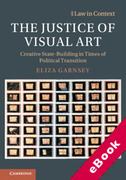
In the aftermath of mass conflict how is it possible to address violent and traumatic pasts, reconcile divided nations, and strengthen state institutions? This study explores the connections between transitional justice and visual art in order to answer that question. Garnsey argues that art can engage and shape ideas of justice. Art can be an inquiry into, and an alternative experience of, justice. Art embeds justice on different political levels-both local and global. Art becomes a radical form of political participation in times of transition. Arising out of extensive fieldwork at the Constitutional Court of South Africa and the South Africa Pavilion at the Venice Biennale, which included 130 interviews with key decision makers, the book provides the first substantive theoretical framework for understanding transitional justice and visual art, and develops novel conceptions of visual jurisprudence and cultural diplomacy as forms of transitional justice.